
Welcome to the ALS Canada blog where you’ll find a collection of articles and updates on ALS-related topics. We strive to develop content that our community will find valuable and deliver up-to-date information about ALS research, community-based support, and advocacy initiatives. We also provide Ontario fundraising event updates and share personal stories about people and families living with ALS in Ontario to keep our community connected. For content in French, please refer to the “Français” category in the main menu.
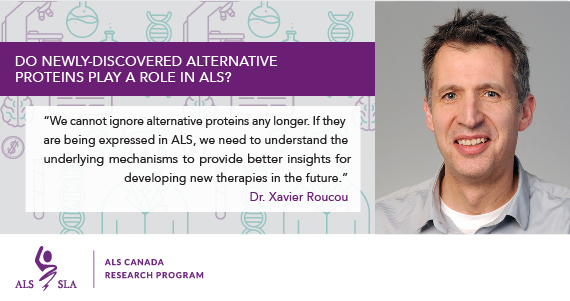
Do newly-discovered alternative proteins play a role in ALS?
March 13, 2019
Proteins are essential building blocks the body uses to make tissues such as muscles, cartilage, skin and blood. Conventional science assumes that a section of DNA known as a gene provides instructions for a single protein, or “encodes” a single... Read More
Posted in: Research
Tagged:

ALS Research Matters
March 12, 2019
The realities of living with ALS – a challenging and terminal disease - led Carol Skinner and Eddy Lefrançois, two Canadians affected by ALS, to start a letter-writing campaign. The campaign encouraged fellow Canadians to contact their elected federal representative... Read More
Posted in: Advocacy
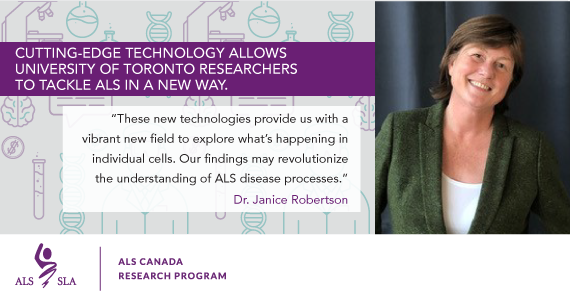
Cutting-edge technology allows University of Toronto researchers to tackle ALS in a new way.
March 6, 2019
Scientists have discovered variation within different areas of the brain and spinal cord of people living with ALS — some areas show greater degeneration while others are unaffected. With a $125,000 project grant from the ALS Canada Research Program in... Read More
Posted in: Research
Tagged:
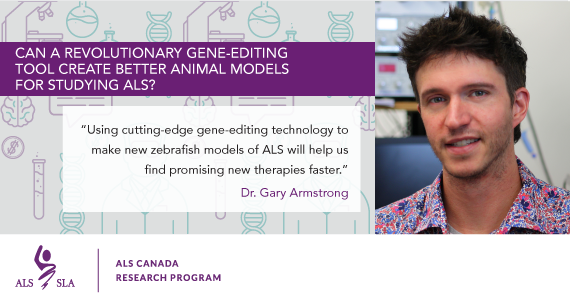
Can a revolutionary gene-editing tool create better animal models for studying ALS?
February 27, 2019
Animal models enable scientists to study human diseases in lab settings. They help scientists learn about the biological changes that occur during disease onset and progression, and they can also speed the identification of promising therapies for testing in future... Read More
Posted in: Research
Tagged:
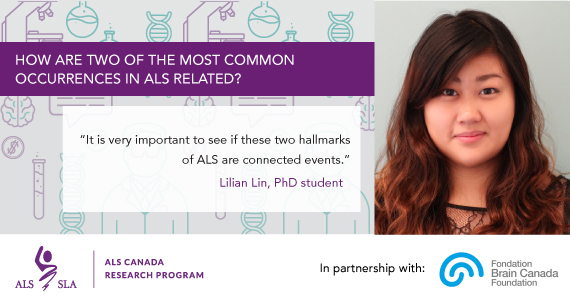
How are two of the most common occurrences in ALS related?
February 20, 2019
Scientific discoveries are like puzzles. At first, two puzzle pieces may not appear to fit together, but then a new way of comparing them makes it possible to see how they connect, helping to fill in the picture. Mutations in... Read More
Posted in: Research
Tagged:
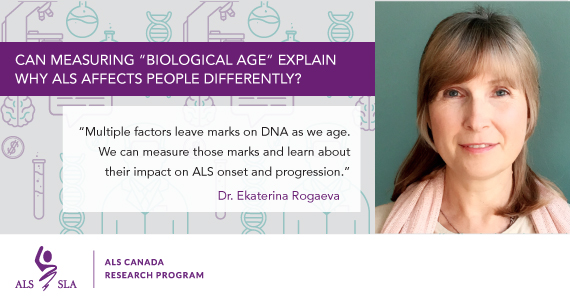
Can measuring “biological age” explain why ALS affects people differently?
February 13, 2019
ALS manifests very differently among people who develop the disease. It can occur anytime in adulthood. People usually only live two to five years after diagnosis, but it can range from six months to more than 20 years. Some people... Read More
Posted in: Research
Tagged: